
The Plan That Got You Here Probably Won't Get You There.
Updated: May 11
By David Meffert CFP, Private Wealth Adviser, Linea Private Wealth
There’s a kind of financial pressure that successful people rarely name. It’s not the pressure of not having enough. It’s the pressure of having accumulated more than the structure was designed to hold.

Income has grown. Assets have been acquired. Entities have been established over the years as needs changed. But no one has ever sat down and asked the question that matters most at this stage: does the original strategy still work for where I actually am?
In most cases, the needs have changed. That’s where a Financial Adviser can help.
Growth Creates Structural Lag
When financial decisions are made in the moment they make sense. A new trust is established for asset protection. A company is set up to hold a business interest. Property is acquired in a personal name because that was the simplest path at the time. Each decision made sense and solved the problem at that time. The problem is that they were made sequentially, not as part of a coordinated plan.
Over years of growth, the result is a financial picture with multiple moving parts that have never been considered together. Entities that could be coordinating are operating independently. Tax positions that could be optimised across structures are being managed in silos. Capital that could be working harder is sitting where it landed.
This is structural lag. It happens when growth outpaces design.
The Five Clues Your Structure Hasn’t Kept Pace
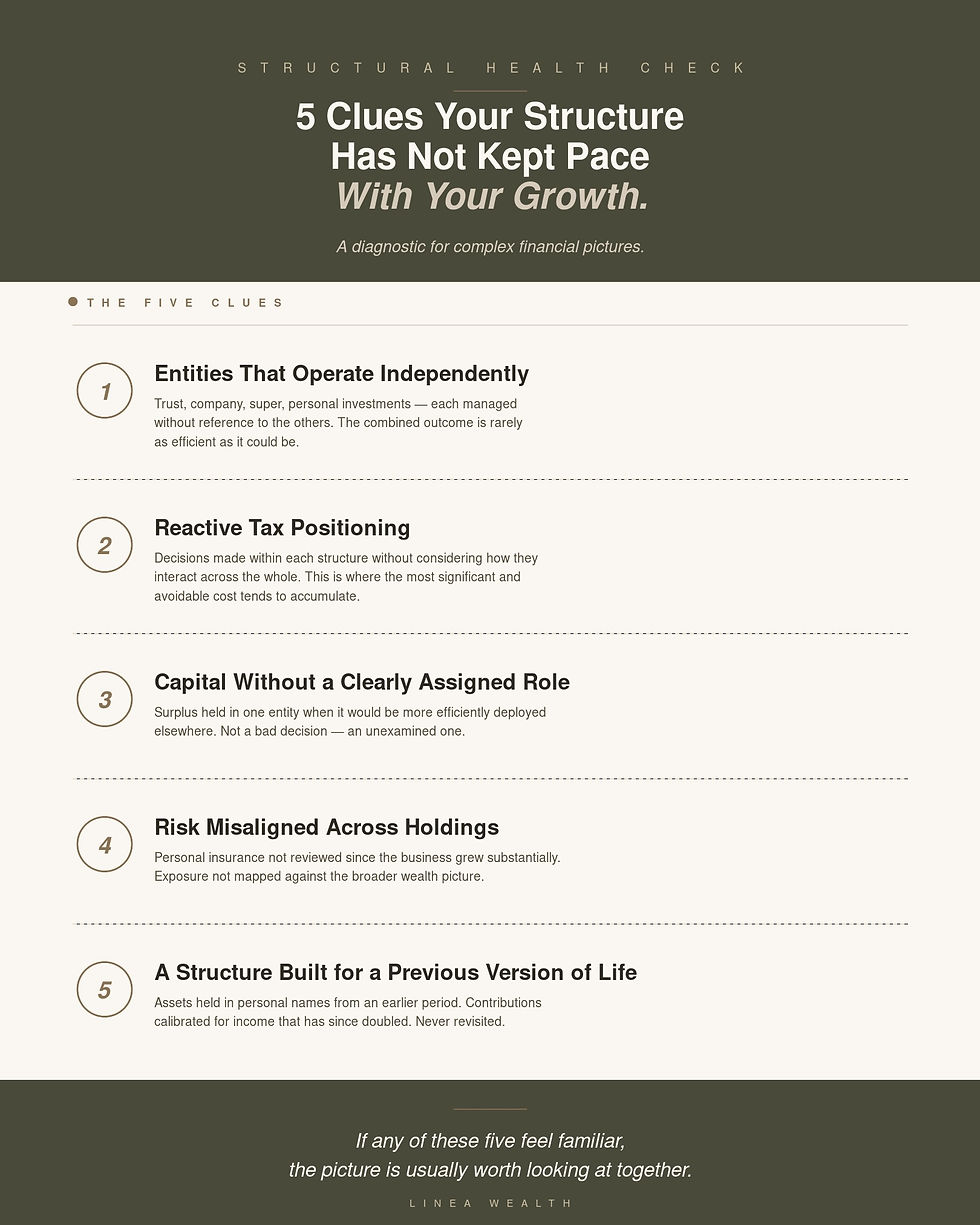
The first clue is entities that operate independently. A trust, a company, a super fund, and personal investments, each managed without reference to the others. The combined outcome is hardly ever as efficient as it could be.
The second clue is tax positioning that is reactive rather than deliberate. Decisions made within each structure without considering how they interact across the whole picture. This is where the most significant and avoidable cost tends to be.
The third clue is capital without a clearly assigned role. Surplus held in one entity when it would be more efficient somewhere else.
The fourth clue is risk that is misaligned across holdings. Personal insurance that hasn’t been reviewed since the business grew.
The fifth clue is a structure that was designed for a previous version of life. Assets held in personal names from an earlier period. Super contributions for an income level that has doubled. Arrangements that made sense five years ago and have never been revisited.
Coordination Is the Work
The conversation I have isn't about finding better individual products or picking a superior investment strategy. It’s about coordination. How do the parts of this financial picture interact? Where are the inefficiencies from things operating independently? What would this look like if it had been designed deliberately for where you are now?
What changes in the conversation is realising that nobody's ever actually looked at how all the pieces fit together. That part's just never been the job.

I worked recently with a business owner in his late forties who had built a genuinely complex financial picture across almost two decades. Multiple trusts. A company structure. Significant super balances. Investment property. His individual decisions had been sound throughout. But when we looked at everything together, the structural gaps were clear. Tax being crystallised unnecessarily through one entity. Capital sitting idle where it was losing ground. Super contributions that hadn’t been reviewed since his income crossed a threshold that changed the optimal strategy.
The work was incremental. The difference it made wasn't. A structure designed to coordinate produces outcomes that an assembled one rarely reaches, regardless of the quality of its individual parts.
A Question Worth Asking
If your financial picture has grown significantly in the last five years, you likely shouldn’t be following the same plan. The advice you should be looking for is whether the structure as a whole still works for where you are now.
Growing without anything tying it all together is pretty common. And the fix isn't more complexity. It's just being a bit more intentional about how it's all set up.
If that's hitting close to home, it's usually worth sitting down and looking at the whole picture together.
This advice is general in nature and does not take into account your objectives, financial situation or needs. You should consider whether the advice is suitable for you and your personal circumstances.


